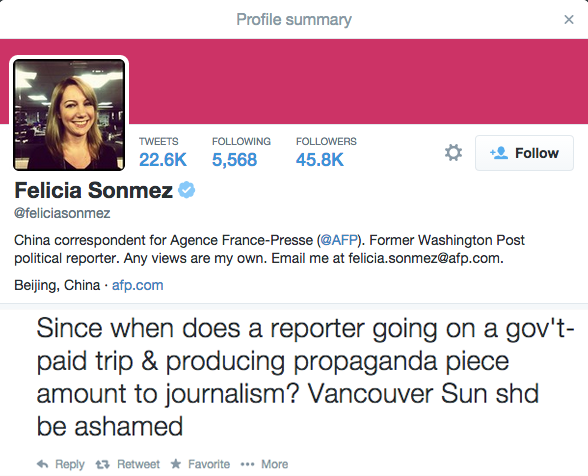
Simon Houpt of The Globe and Mail just posted this story:
“Journalist Jesse Brown is quick to expose the failures of Canadian media. But what about his own?”
The following is taken directly from his email interview with me. I’m reprinting, unedited, the parts that pertain to the allegation that I once “faked” a scene in a 2006 CBC radio piece.
How would you characterize your experience working on The Contrarians?
Very difficult.
The show was about “unpopular ideas that just might be right”. Each episode, I would champion a controversial argument to see if it had merit. I rarely agreed with these ideas myself, but that wasn’t the point.
One episode was called “multiculturalism doesn’t work, we just eat each other’s sandwiches”. Another was about how feminism had basically achieved all its goals. Another was about how Canada is not a “good guy” on the global stage at all.
I was paired with different CBC producers on this. In cases, advocating for these ideas contradicted their personal convictions. It was a rough go. Management wanted the show to be “edgy” and really “push buttons” while the people I worked with were uncomfortable with the subject matter and suggested topics like “are cottages really so great?” (not kidding). My show’s executive producer also ran The Sunday Edition. She faced a near mutiny from her colleagues over the feminism episode. She wanted to tank it and pursue an episode championing “misandry” instead. I tried to make that one work, but the idea was so ludicrous it couldn’t sustain a 30 minute defence. The feminism episode ran. Our relationship soured, and I no longer enjoyed her support within the building.
Ultimately, management agreed that the show was “edgy” and “button pushing” as requested, and also quite good. But they also had heard about how difficult the production process was and the show wasn’t picked up on those grounds. I pitched Search Engine a short while later, and they green-lit that…
Thanks. Were you ever told that you were the reason for “how difficult the production process was” – and that in fact, as a result of that process, you had a reputation within the building of being obstreperous and difficult to work with? (And yes, I ask this knowing that they greenlit Search Engine a year later.)
Sorry, tied up the past while.
I’m sure some blamed me for the bumps in the process, but I got along splendidly with Lynda Shorten and everyone else before The Contrarians, and I got along well with my team at Search Engine afterwards. From my perspective, the conflict was a direct result of the editorial material. People weren’t comfortable with it.
I can direct you to Geoff Siskind, who produced Search Engine and who can tell you about what it was like to work closely with me at the CBC.
I liked and respected most of the people I made radio with, and I hope they felt the same way, but I won’t argue that I clashed with the CBC culture.
Yes, I realize you had the AMA, so didn’t expect a reply before now. Thanks for getting back to me.
Speaking of the AMA, I saw you referenced a “smear job.” You don’t think that’s what I’m working on, do you?
No, I don’t think you’d set out to do so, and I’m sure you’d consider with caution any dubious info about me that came your way 🙂
So wait – if not me, then who were you thinking of when you floated the idea of a smear piece? Everyone else has already run adoring profiles. (Indeed, I believe we have, too.)
One reporter profiling me told me they had been shopped defamatory info about me, which I knew to be untrue. They wouldn’t say where they got this from.
I have been told on the record that, while developing The Contrarians at CBC, you faked a scene that you included in the pilot. Would you care to respond?
omg sure.
The pilot was “multiculturalism doesn’t work, we just eat each other’s sandwiches”.
In between interviews with writers and academics, we had comic vignettes where I would go into ethnic eateries and kibbitz with the staff. For example, I went into a falafel shop and tried to engage the woman behind the counter in a debate about who has the best hummus, Jews or arabs?
For one of these, I went into San Francesco Foods on Clinton and asked if the guy could put my veal parm sandwich in a roti or a pita instead of a bun. He gruffly said “No, we don’t have that kinda stuff here!”.
But I didn’t get it on tape. So I asked my buddy to gruffly say the same thing.
Later I told my colleague Jane Farrow, a senior producer on The Contrarians, that I had a friend re-create the bit.
We chatted a bit about it- should we do that kind of thing if the show got picked up and actually broadcast? After all, The Current had little comic vignettes at the top of their show, so there was a precedent for mixing staged comedy with hard news/current affairs. I don’t remember her voicing an opinion on this one way or the other. I used the tape for the un-broadcast pilot, and made a note to bring it up later with Lynda Shorten the executive producer.
Weeks later, once the show had been picked up. I was discussing future episodes with Lynda Shorten, and I mentioned that I had re-created the bit and asked if we should do that for on air episodes or not.
She was shocked. She killed the pilot episode, which we later re-did, and she hauled me into management’s office and put a note on my file.
It was surreal. The distinction between the funny parts of the show and the journalism in the show was very clear. And I was happy to simply not do scripted bits in the future. But this was all dealt with humourlessly and with the utmost severity.
Okay. Thanks for your input.
Sure. I have no problem telling that story publicly so long as it’s told honestly, which I trust you to do.
But I am curious about how it came to your attention and what motivated that.
That story is well known within CBC, going back years.
Motivations? Did you ask the women who came to you with allegations of abuse by Ghomeshi what their motivations were?
Yes
And did that negate what they had to say?
No, but had they been motivated by vengeance or a desire to ruin him in service of their own career interests, that would at a minimum have become part of the story.
Thank goodness they were all educated and employed, then.
I’ll tell you about that line someday.
I retract that. My apologies for that last email. I’ve been reading too much Canadaland.
Tonight CBC’s the fifth estate will air an hour-long investigative documentary, titled The Unmaking of Jian Ghomeshi. I participated in this report. I gave the CBC information and documentation from my independent investigation and from my work with Kevin Donovan. I reached out to some of my sources on the CBC’s behalf and asked if they would be interested in participating as well. I gave the CBC extensive interviews, both on and off camera.
This may strike some as an odd choice.
After all, I’ve been highly critical of the CBC’s internal Ghomeshi investigation, which is currently being conducted by lawyer Janice Rubin. I felt that in that instance, the very idea that the CBC could be expected to do an honest job of investigating itself was a joke. So why have I now participated with a CBC news investigation?
It wasn’t for money. This was a different kind of partnership than my work with the Toronto Star; I volunteered my time and efforts to the fifth estate and officially I am simply a source in their report. It wasn’t for attention; I’ve turned down every request for a TV appearance about the Ghomeshi case before this one.
I helped the CBC (or more specifically, I helped some of the CBC’s last remaining investigative reporters) because they are in a unique position to find and report the truth about CBC management’s role in the Ghomeshi case. Since parting company with the Toronto Star, my own investigation has focused directly on CBC management. I have learned and reported some information on this, but my access to the highest levels of the organization is very limited, and my requests for comment are met with curt denials when they are answered at all.
The fifth estate‘s Gillian Findlay, her executive producer Jim Williamson, and senior producer Julian Sher promised me that they too were specifically interested in investigating CBC management. They have assured me that they have both the will and the license to hold their own bosses to account, even if it means implicating people they have personal friendships with. And they have institutional knowledge and access that I do not.
I chose to trust them.
The worst case scenario is that the fifth estate‘s report will be like the two CBC interviews executive Heather Conway requested and received in the early days of this story: a carefully managed attempt to provide the appearance of accountability with none of the substance. If I’ve helped the CBC fool its audience into thinking the broadcaster has properly dealt with this and we can all move on, I apologize in advance.
How will we know?
There will be many indications. In their advance hype for tonight’s episode, the fifth estate has promised “numerous revelations”. Perhaps some of these will concern the instances in which management was directly exposed to Jian Ghomeshi’s inappropriate behaviour. After all, Ghomeshi’s activities were not constrained to his staff. He rode in elevators with management and rubbed elbows with top executives at galas and fundraisers in Toronto and Ottawa. Ghomeshi was a fixture at these parties, where he was known as as a brazen operator. Is it credible that no CBC executive saw anything firsthand? Were they ever told about an incident after the fact? Perhaps we will learn something tonight.
Ultimately, there is one way we will know for sure if the fifth estate is for real. It has nothing to do with hints, warnings or red-flags that CBC executives might have heeded before anyone knew about the severity of Ghomeshi’s actions- it has to do with the direct behaviour of management at the highest levels, once they knew the truth.
In his infamous Facebook post, since deleted (possibly as a condition of his settlement with the CBC,) Jian Ghomeshi wrote:
“I was given the choice to walk away quietly and to publicly suggest that this was my decision.”
If true, this offer to deceive the public and cover up crimes would have been made to Ghomeshi by CBC executives after he showed them photo evidence that he had brutalized a woman. It’s possible that Ghomeshi was lying about this. But it’s unlikely: if such an offer was made, lawyers on both sides would have been present.
So: was this offer made by CBC management? If so, by who exactly?
For the fifth estate‘s investigation to be credible and legitimate, their report must at the very least pose these questions.
And that’s how we’ll know.
Finally, there is another reason why I helped the CBC. It’s an idealistic one from a recovering public broadcaster, a small hope that the many responsible and principled journalists still within the CBC might reclaim the place from those who have driven it into the ground in every conceivable way.
The only way the CBC can present itself to Canadians as an organization that is still in the business of telling the truth is by cleaning up its own damn mess.
I really hope they do.
In walking back its ban last week of retiring journalist Linden MacIntyre, the CBC presented the public with an official version of events which describe the decision to punish MacIntyre as a “heat of the moment” mistake by one CBC manager, Jennifer Harwood.
CANADALAND has learned that this is not true.
The fix is in.
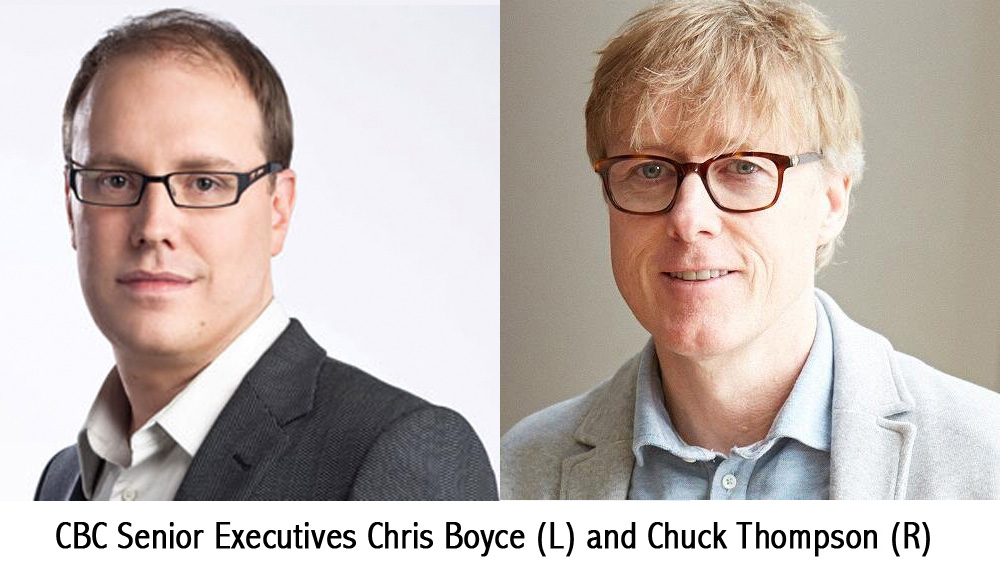
Information released today by Chuck Thompson, CBC’s Head of Public Affairs, reveals the broadcaster’s impending 3rd party investigation of the Ghomeshi scandal to be a pre-determined cover-up and whitewash.
Lawyer Janice Rubin’s report will never be released to the public. What’s more, the CBC now admits that Rubin has been contracted only to investigate past and present employees of Ghomeshi’s shows, Q and Play. Rubin has no powers to demand answers, and no mission to learn who knew what and when. Participation in the investigation seems to be entirely voluntary.
Most strikingly, Rubin has no mandate to look into CBC management’s role in the Ghomeshi affair whatsoever.
Yet management is already implicated. Here is what we know so far:
1. in 2010, a Q producer complained about Ghomeshi to a union representative, who took her complaint to Q Executive Producer Arif Noorani and to Kim Orchard, then the CBC’s Director of Arts and Entertainment. The producer says she is absolutely certain she included her allegations that Ghomeshi told her he wanted to “hate fuck” and “grudge fuck” her, and that he touched her inappropriately. She chose not to file a formal grievance, as doing so would mean facing Ghomeshi directly with her accusations, which she felt certain he would simply deny. This meant no paper trail was created.
Arif Noorani said to CANADALAND that when the union rep approached him with his employee’s complaint, “sexual harrassment” was not mentioned.
When asked if “abuse” of any kind was mentioned, Noorani did not respond.
Kim Orchard, now retired, also denied to CANADALAND that “sexual harrassment” was mentioned.
When asked if “abuse” of any kind was, she said “no”.
2. As reported in the Globe and Mail today, 6 members of the Q team met with Linda Groen, CBC’s Director of Network Talk, in July 2012 to complain en masse about Ghomeshi’s behaviour. Though sexual harrassment was not mentioned, the team reportedly described to management a culture of fear and manipulation created by Ghomeshi and tolerated and enabled by the CBC. The Globe writes that the Q staff had to meet away from the CBC’s offices so as to escape Ghomeshi’s awareness. Management’s failure to act on these drastic warnings will evidently not be examined by Janice Rubin.
3. In his infamous Facebook posted self-defence, Ghomeshi claimed that CBC management gave him the option to misrepresent to the public the reasons for his departure.
“I was given the choice to walk away quietly and to publicly suggest that this was my decision,” he wrote.
Unless Ghomeshi is lying about this (and the CBC has not denied it) the broadcaster was willing to conspire with Ghomeshi to hide from the public the true reason for his dismissal: that he showed them evidence that he had injured a woman.
There is evidence to suggest the CBC was keeping open the option to do just that:
At 3:58pm on October 24th, I tweeted what I had learned from a source that the CBC had put Ghomeshi on “indefinite leave,” CBC-speak for “fired”.
8 minutes later, CBC spokesperson Chuck Thompson tweeted a direct denial: “Jian Ghomeshi is not on indefinite leave from the CBC”.
by 5:30pm, the CBC had put word out through the Canadian Press that Ghomeshi was on “indeterminate leave”.
The semantic shuffle is curious. If the CBC simply fired Ghomeshi, why dispute the term “indefinite leave”? Better yet, why not just say that he had in fact been fired?
The answer may have been that as it was two days before Kevin Donovan and I published our expose on The Toronto Star’s website, the CBC’s brass were still hopeful that the truth might never come to light.
If that’s the case, we may never know.
****
Here is the new release from Chuck Thompson:
From: Chuck Thompson Sent: November 6, 2014 Subject: Terms of reference for Janice Rubin Mandate
Janice Rubin will be engaged by CBC/Radio Canada to carry out the following mandate:
(a) Current and former CBC/Radio Canada employees who worked on the “Q” or “Play” programs during the period in which Jian Ghomeshi hosted these programs and who have complaints, concerns or experiences they wish to share regarding harassment, discrimination, violence or other inappropriate workplace conduct during their work on these programs will be directed to contact Janice Rubin.
(b) Janice will make available to such employees an accessible and secure telephone number (with sufficient voicemail capacity) and email address through which they can contact her directly and she will acknowledge receipt of each message sent to her as soon after receipt as is reasonably possible
(c) Janice will arrange to meet each employee as soon as possible. Some employees may only wish to discuss with her their concerns or experiences without any further action being taken. However, if any employee has a specific complaint that they wish to have investigated, she will do so in accordance with applicable CBC/Radio Canada policies. Janice will gather all of the material facts, including the identity of all individuals involved, the specific conduct complained of and the date(s) and time(s) on which such conduct occurred.
(d) Janice will conduct all of your meetings as confidentially as possible. CBC/Radio Canada will fully co-operate with Ms. Rubin in completing her mandate and will ensure that she has access to any CBC/Radio Canada personnel to whom she may require access, and any CBC/Radio Canada documents to which she may require access, in the course of completing her mandate.
(e) Following the completion of her investigation, she will prepare and deliver to CBC/Radio Canada’s Vice President, People & Culture, or other individuals designated by CBC/Radio Canada, a final written report which sets out:
(i) A summary of the complaints, concerns or experiences shared by her, maintaining confidentiality to the extent possible;
(ii) Ms. Rubin’s findings to the extent you are able to make them with respect to each specific complaint that you are asked to investigate; and
(iii) Ms. Rubin’s recommendations as to any steps CBC/Radio Canada should take to resolve the complaints, concerns and experiences shared with her and to prevent similar issues from arising in the future, including any recommended changes to CBC/Radio Canada’s policies and procedures related to harassment, discrimination, respect in the workplace and workplace violence and the investigation of these issues.
(f) Following delivery of Ms. Rubin’s report to CBC/Radio Canada, she will meet with CBC/Radio Canada to discuss the same.
(g) The scope of your mandate may also be amended by agreement.
Chuck Thompson Head of Public Affairs CBC English Services
CANADALAND has learned that last year the CBC acquired NSA documents describing a major CSEC surveillance program, but the public broadcaster has been sitting on this news for over nine months, with no immediate plans to publish.