Mary Rogan’s cover story in this month’s Toronto Life promises to deliver “the untold story of the cop who pulled the trigger” in the shooting of Sammy Yatim.
Indeed, a detailed biography of police officer and accused murderer James Forcillo is presented, with his childhood, his stylish wife, his years of service and his “shy, quiet” personality all described. A photo of Forcillo pushing his baby daughter in a swing is included. But before that, Rogan provides a quick account of Sammy Yatim’s last moments unlike any other that has appeared in the press to date.
A “good shoot”?
According to Rogan, Sammy Yatim tried to slash a woman’s throat shortly before he was shot to death by Const. James Forcillo. He also lunged at a streetcar driver with his blade, she writes, and could have reached Forcillo “in one leap” had the officer not shot him. What’s more, if Forcillo had allowed Yatim to exit the streetcar, innocent bystanders would have been in the line of police gunfire, and so Forcillo’s actions, Rogan’s piece suggests, were consistent with his training.
“That’s absurd,” says lawyer Peter Rosenthal, who has represented the families of people killed by police, and who has followed the Yatim case closely. “The video speaks for itself and speaks very loudly. Yatim wasn’t exiting the streetcar. We can see that he was not in a position to harm anyone. His killing can’t be described as anything but a methodical execution.”
Rosenthal also takes issue with Rogan’s explanation of the “21-foot rule,” an aspect of police training that defines a danger zone between an officer and an armed suspect within which lethal force might be justifiable.“ Forcillo stood roughly 12 feet from the streetcar door, writes Rogan, with Yatim not far behind it, placing the teen well within the danger zone.
“But (the 21 foot rule) only applies if the officer’s gun is in its holster,” says Rosenthal. “She doesn’t mention that.” Forcillo’s gun was of course drawn, and aimed directly at Yatim throughout the standoff.
Peter Rosenthal isn’t the only one challenging the Toronto Life story.
An Uncanny Resemblance
CANADALAND has spoken to reporters assigned to the Yatim story who say that Mary Rogan’s account of events is indistinguishable from defense statements made by Const. James Forcillo’s lawyer. Due to a publication ban on evidence and testimony from the trial, these reporters have chosen to withhold their names.
At Forcillo’s preliminary hearing, his lawyer Peter Brauti made an opening statement that bears “an uncanny resemblance” to the account found in Rogan’s article, says a reporter who was present in the courtroom. Another reporter wonders if Rogan, who was not present at the preliminary hearing, may have skirted the publication ban if Brauti presented his version of events to Rogan outside of the courtroom. Rogan did indeed interview Brauti for the piece, but she writes that he couldn’t discuss specifics of Forcillo’s case. Nevertheless, Rogan confirms to CANADALAND that Brauti was present whenever she interviewed Irina Forcillo, the wife of the accused officer.
Exclusive Access
Irina Forcillo, unlike her accused husband, is not prohibited from speaking to the press about the case. But for months, she declined every interview request. She broke her silence for Mary Rogan, assumedly with the blessing of her husband and of Peter Brauti. CANADALAND asked Mary Rogan why Irina Forcillo would speak to her and no-one else.
“I’m not sure,” Rogan answered. “It’s a question I’ve been asked many times before regarding other pieces. Who knows why people ever decide to talk?”
Rogan says that no terms were placed on the interview by Forcillo or Brauti. She stands by her story, saying she is “confident that what I’ve written in my piece is accurate and was thoroughly fact-checked.” Toronto Life editor Sarah Fulford (FULL DISCLOSURE: I am a former Toronto Life columnist and a friend of Fulford’s) also supports the story. “I can say with confidence that Mary’s description of what happened on that streetcar is correct,” she writes. “Her sources are good”.
But who are these sources? Where did Rogan get her information from, if not from Forcillo and/or Brauti? Was her detailed account based on video evidence the public has not yet seen? One reporter who has viewed unreleased footage says that it does not confirm Rogan’s account. “It’s unclear what’s going on (in the tape)” says CANADALAND’s source.
An authoritative account?
CANADALAND asked Mary Rogan how she could be so sure that Yatim did what she says he did. None of the eyewitness accounts quoted in the press to date seem consistent with her telling. One witness on the streetcar, Aaron Li-Hill, told the Toronto Star that Yatim was moving too slowly to seem like a real threat. Did Rogan speak to other eyewitnesses who felt otherwise? Or did she rely on police officers and their lawyers for her information?
“I am not prepared to reveal sources,” writes Rogan, who declined to answer the majority of CANADALAND’s questions.
The other side
One source Rogan certainly did not rely on is Julian Falconer, the lawyer representing the Yatim family in their civil suit. If he, or the Yatims, have a different version of events, it is not included in the Toronto Life piece. In fact, Rogan never interviewed Falconer.
CANADALAND reached Julian Falconer by phone. He wouldn’t comment directly on the Toronto Life story or the case, but he did say this:
“In cases like this, there are real incentives to provide narratives and counter-narratives. I’d rather deal with solid evidence in court”.
***
*
***
Here is Mary Rogan’s response to CANADALAND’s questions:
Did you approach Irina Forcillo directly, or was your access to her arranged through a lawyer?
Peter Brauti was present for my interviews with Irina to ensure the publication ban was not violated.
Irina has turned down every other media request, I believe. Why did she talk to you?
I’m not sure Jesse. It’s a question I’ve been asked many times before regarding other pieces. Who knows why people ever decide to talk?
Were any terms discussed/agreed to, with Irina or Peter Brauti?
No
On to the piece itself…
Most of the questions that follow from here can be answered yourself, with research, or were gathered from various sources, fact checked and I’m not prepared to reveal those sources.
You write: “Yatim had a stiletto switchblade and had tried to slash the woman’s throat.” This is a major new piece of information in this story, which I believe has not been previously reported.
Can you provide any context at all on how you know this?
(no response)
Were you present for the opening statements of the preliminary trial?
I did not attend the preliminary hearing
Did you see the TTC surveillance tape?
(no response)
Did you speak to any of the firsthand witnesses?
(no response)
Are you confident that this is fact, that Yatim’s intent was to slash her throat, or is that an interpretation of his intent?
(no response)
Why was he unable to make contact?
(no response)
This Toronto Star story quoted a man on the streetcar who didn’t feel Yatim was a threat. Did you talk to this witness, or other streetcar passengers who felt differently?
(no response)
You write: “The driver bolted just as Yatim lunged at him with the knife.” Who was your source on this? Did you speak to the driver?
(no response)
Is there any question in your mind as to whether or not Yatim was actually trying to stab the woman and the driver, or just menace and intimidate them?
(no response)
You write: “Behind Forcillo, passengers were talking about what had just happened on the streetcar”. No crowd is visible directly behind Forcillo and several other officers in the videos. Were they directly behind? How far behind?
(no response)
You write: “He could have reached Forcillo in one leap.” Is this your interpretation of the physical circumstance, or someone else’s?
(no response)
You write: “If he jumped out into the crowd with his knife, Forcillo wouldn’t have been able to use his gun without endangering bystanders.” Is this your reasoning/observation, or someone else’s?
(no response)
You write: “Yatim turned away and stepped back into the interior of the streetcar, then appeared to make a decision.” Appeared that way to whom? What was that decision?
(no response)
Why is Julian Falconer not quoted in the piece?
Because I didn’t interview him
Is it accurate to describe your piece as James Forcillo’s side of the story?
I’ll let reader’s decide how they want to see this story. For my part, I wanted to push past the predictably polarized interpretation of what happened and create a broader discussion. I hope I’ve done that.
Reporters tell CANADALAND that Toronto Life’s version of he story is indistinguishable from defense statements made by Const. James Forcillo’s lawyer.
Article Images
Show notes
The Score is a digital-first, globally popular Canadian media company that’s growing each year. So why did its well-loved feature writing team just get the axe? Former features editor Dustin Parkes explains.
Episode Rundown
00:00 The Score lays off its feature writing staff (link)
03:13 “I’ll ask you questions and you’ll have to explain it to me like I’m a very slow four year old because with sports, I don’t really know anything.” Jesse
05:38 “We were like, ‘look at these media dinosaurs going out’ and you know what? In two years, we were the dinosaurs.” Parkes
07:15 “In defending my team throughout the last year and a half, I would look at the shares per article. Ours would always be higher, ours would always be more significant. But you know, we cost more money than the average news editor.” Parkes
7:43 “(a news editor) is what used to be called a blogger. They’re the people who are kind of mining for content, mining online, mining Twitter, social media and looking for the breaking stories.” Parkes
8:40 “By the simple metrics, I could see they were generating more page views and a lot more tap throughs on the app, a lot more views online, a lot more shares online overall.” Parkes
10:30 “They found new ways to share on Facebook that were very effective for them and that kind of cut out the need for us as marketers of their product…Facebook recently changed their algorithm for sharing content and they made sharing content for content providers a lot easier. Using hashtags, and made it more like twitter. And that had a profound effect on our traffic numbers.” Parkes
11:53 “They’re selling $2 million per quarter in ads…it’s up 60% from a year ago. And yet when you consider they’re like the number 3 thing in the world in what they’re doing (Chris corrects- they’re currently #7), and they’ve got an audience of 5 or 6 million- in newspaper terms that’s a pittance. And they’re losing $2.7 million every quarter cause their spending over 5 million a quarter. When the numbers are that big…I’m going to make a wild estimate and guess your whole team cost somewhere around half a million dollars a year?” Jesse
“It’s a lot less than that” Parkes
The Star on The Score’s path to profitability (link)
12:30 “They’ve got a 100 people in there (The Score), 30 of them are journalists? So is everyone else a computer programer?” Jesse
12:40 “It’s a modern company in every way” Parkes
“Is that what a modern company is? Is a modern media company a company without journalists?” Jesse
“In a way, it’s starting to shape up this way” Parkes
14:00 “ That which gains the most traction as far as news content goes is the weird stuff, the wacky stuff in sports…What we as the feature writers offer is something a little bit more than that and it’s kind of for the people who have an unhealthy relationship with sports” Parkes
14:49 “(You wrote) an article about the exploitation of young Dominican kids into baseball, that was as good as any magazine journalism I read recently” Jesse (link)
15:26 http://grantland.com/ (Maybe the only sports website I frequent. -Chris)
16:12 The personal blog post Dustin mentions (link)
19:02 “’The market can’t support this type of journalism, we’ve learned this is true’. Actually, you’re talking about specific people called advertisers, who are obsessed with metrics,eyeballs and clicks. They don’t particularly care about the quality of the content, they just want people seeing their ads, and where does the value lie when people ignore display ads?…are we acting like this is the reality of the world when we haven’t educated advertisers and they don’t understand the difference between one kind of click and another?” Jesse
24:15 Some of Dustin’s World Cup coverage (link)
24:50 “To be really honest it’s sports, I mean it’s so meaningless. Like, maybe tabloid journalism is maybe a little bit under it. In the end it’s completely meaningless, it’s at best a distraction.” Parkes
Excerpt
The Score is a digital-first, globally popular Canadian media company that’s growing each year. So why did its well-loved feature writing team just get the axe? Former features editor Dustin Parkes explains.
Show notes
Episode Rundown
0:42 The eulogies of MuchMusic (link) (link) (link)
01:50 Greg O’Brien, Editor & publisher of Cartt.ca (link)
03:12 Moses Znaimer (link)
03:28 Peter Nygard (link)
04:58 “…under their CRTC licence, they have to air 12 hours of music videos everyday. They accepted that when they took ownership of the licence. When they bought it from CityTV” – O’Brien. They call it “Beaver hours” (link)
05:21 “They have to play these music videos. It’s in the logs and they have to prove it to the commission that they play this much hours of music videos.” O’Brien
5:46 (CRTC staffers enforce this) but they only act if someone complains… If someone complains that a channel is violating its licence. You know, if Sportsnet starts showing womens programing or if W network starts showing hockey” – O’Brien referring to how a channel could get in trouble if they broke their licence agreement.
Make your complaints here. (link)
06:38 “It was a cash cow for a long time. Same thing for History, nobody else is allowed to launch, in Canada, a history channel because Shaw owns that genre protected licence” – O’Brien
07:32 (other channels can play videos) “…as long as you don’t call it a music video station or don’t play too many.” – O’Brien.
08:15 “If Shaw has a claim on history, I can’t come into the market with a competing History Channel. Does that mean they have to have history programming? Because when I watch the History Channel, I’m not seeing a ton of educational history stuff.” Jesse
Cracked has the best take of the decline of the History Channel (link)
09:22 “Ice Road Truckers is an historical show because we have historically had ice roads.”
10:01 “In return for launching that channel, because our market is so small, the CRTC would say that it’s your channel, you will be the only one that has that channel. And you’ll be able to go to market free of competition.” O’Brein
10:22 “If we had allowed Comedy Central just to come into Canada, we wouldn’t have a comedy network in Canada.” Some say that would be a good thing.
12:00 “Book Television is the example we use to illustrate the problems in the industry” O’Brein. Follow-up story (link)
12:32 “Book Television has half an employee assigned to it.” (link)
13:21 “It makes about $4.5 million a year on subscriptions because their in these big bundles.” O’Brein talking about Book Television (link)
14:27 This hearing (link)
19:08 “Don’t get so carried away. ‘The government could force us to unbundle it, but you’re not going to save a dime.’ If we’re not going to save a dime, why would they be fighting it so doggedly for years? Obviously they’re afraid of something.” -Jesse
20:01 “Rogers will speak at length about the experiment they did in London (Ontario) where they broke up the packages as best they could…and let people buy one at a time, and hardly anybody took them up on the offer.” O’Brein (link)
25:11 “Given the choice, Canadians choose American programming and, like you say, if we just let the American stations come in here (over the Internet)…Canadians will choose that.” Jesse
26:08 “Disney last week signed a deal with Netflix. Netflix will be the exclusive Canadian partner for all of the animated and live action movies for Disney starting in 2015.” O’Brien (link)
26:54 “The Canadian market is really unique when you look around the world. We are right beside the world’s biggest cultural producer, and we’re the same language.” O’Brien
27:25 Nope, “protectionary” isn’t a word (link)
34:34 “There are two things intended by this CanCon production scheme. One is, it created an industry, and it certainly succeeded in doing that. It totally created a Canadian production industry. And the other thing it’s supposed to do is create Canadian culture that’s supposed to be of value to Canadians. I think we can conclude after a pretty good amount of time that it has failed miserably at creating that culture.” Jesse
35:00 The Littlest Hobo is a rad hobo dog solving small-town problems. It was the dark gritty reboot to Lassie we’ve all wanted (link)
35:05 “It is well past the time where the industry can continue to live on renting American programming. If we’re going to a pick and pay world, you’re going to have to give people a reason to pick and pay for you.” O’Brien
35:20 The Beachcombers circa 1975 (link)
40:01 Showmi hype (link)
Last week, Rogers announced that they were getting out of the snitch business. Until then, the company ratted out its own customers to government agencies hundreds of thousands of times every year. Without asking for a warrant, Rogers provided subscriber data to authorities that linked real names to all kinds of private online expression and activity. On a previous episode of CANADALAND, The Citizen Lab’s Christopher Parsons described the common practice among telecom companies of charging police and other agencies a fee of $5-$15 each time they came knocking.
The Supreme Court has since ruled that this kind of warrantless information sharing is an illegal violation of individual privacy. Only then did Rogers desist, and I took the opportunity to remind people just what they had been up to, over a period of time that we learned in today’s Toronto Star stretches back to at least 2006. Here’s what I tweeted:
This is huge. Rogers previously sold the data of 100s of thousands of customers to police w/out warrants. No more. bit.ly/Wb3PF3
I soon received a public response from “Chris @ Rogers” (@Rogers_Chris), an official Rogers social media presence who I will assume is an actual person.
@JesseBrown We do not sell data to police, we comply with the law and respond to legally valid requests from police.
Of course, in complying with thousands (millions?) of warrantless police requests, the highest court in the country has ruled that Rogers was in fact not complying with the law, but let’s leave that aside for a moment and deal with the matter in contention: was subscriber data provided by Rogers for free, or did police pay for it? Suspecting that Chris was relying on some semantic quibble about the difference between the terms “charging a fee” and “selling,” I asked for clarity in my response:
@Rogers_Chris do you charge a fee of any kind when supplying basic subscriber data?
Chris wrote back suggesting that we take the conversation private. He promised to have someone “more familiar” with this issue follow up with me via email. That was last Thursday.
I’m still waiting.
UPDATE – JULY 28 –
A Rogers rep, Kevin Spafford, got in touch after I posted the article above. He confirmed that “in some cases we charge a minimal fee” when providing law enforcement officials with customer data. When asked how much this fee is and how often it is charged, Spafford declined to provide details, answering instead that the fee varies depending on the amount of work required to provide the information, and that “in most cases” no fee is charged. Given the enormous volume of data requests, this leaves much room for interpretation, leaving the public in the dark as to whether Rogers has been collecting hundreds, thousands, or millions of dollars in return for providing information to police on its customers.
CANADALAND has obtained internal CBC documents illustrating how the organization is dealing with employee tension, rage and confusion.
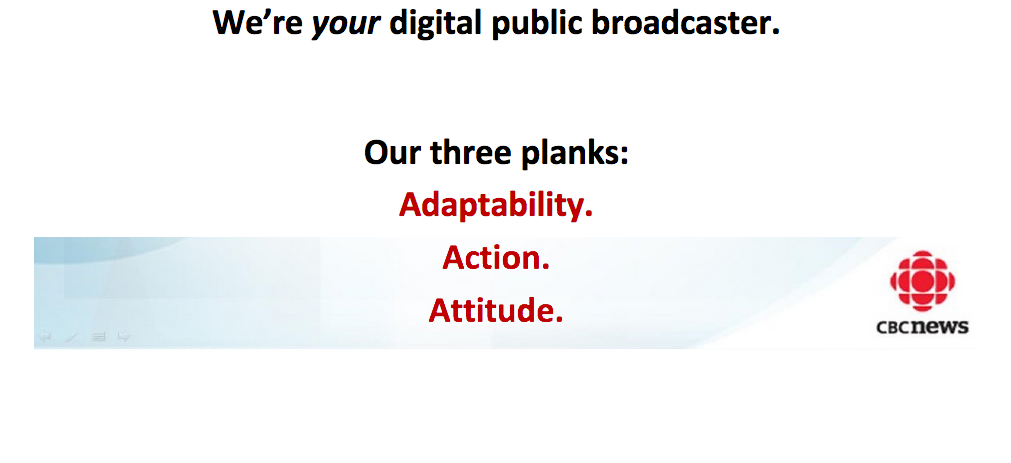
Here is CBC News’ “Digital Mantra”, also titled “CBC Digital Strategy in 3 Slides” (link)
Here is management’s attempt to answer questions submitted by employees following last month’s employee town hall (link).
The CBC work atmosphere has by all accounts hit a new low since the town hall, where employees hoped to learn whether or not they would be keeping their jobs. Instead, they were forced to endure President Hubert Lacroix’s “Vision 2020” unveiling, a smokescreen of digital futurism bafflegab that obscured the painful truth, that 1500 unspecified positions will be eliminated over the next 5 years. While each employee waits to find out if they’re getting the axe, they are expected to internalize and execute the CBC’s “digital mantra”, which will result in news content designed for phones and tablets, somehow (it has to do with “pillars” and “planks”).
A couple of brave (doomed?) workers actually piped up to demand Lacroix’s resignation for running the whole enterprise into the ground (he refused) and the whole affair was hustled to a premature close as questions were still being hurled at the stage.
Employees were assured that all queries would be answered if submitted via email. The results of that process have since been posted to the CBC’s iO! employee intranet and then leaked to CANADALAND.
The full document is a slog of mendacious, obfuscatory doublespeak. So, for your reading pleasure here are the
TOP 5 BAFFLING BITS OF CBC MANAGEMENT JIBBERISH
1. “The strategy is a plan, not a blueprint.”
Those are just synonyms.
How about: “the scheme is a gambit, not a ploy” or “the excuse is a justification, not an alibi”?
Take into consideration the context, and it’s even more angry-making. Here’s the employee question it purports to answer: “If you don’t have any specific, concrete numbers about how this will impact us, why are you sharing the strategy?” In other words: you still haven’t told us who’s getting fired, so why are you bothering us with this digital future horseshit? Why? Because this isn’t a blueprint, people- just a plan. We call it a strategy.
2. “We are keeping incentive-based compensation for managers…to provide an accountability framework to drive the successful achievement of the Corporation’s annual objectives”
….and that’s why your boss will still be getting her bonus while you’re getting shit-canned. Amazing how management types needs incentives beyond their generous salaries to achieve their goals. Everybody else is expected to do their job because it’s their job.
3. “We are in the content business, not the infrastructure business.”
This lies at the core of the lie. The Vision 2020 plan appropriates the media-exec mantra of the moment: that progressive shops are all about content, cuz the game is no longer about having the most powerful transmitters, the widest network, or the biggest pipes. Let us all be “device agnostic”, let us simply create the best product out there and the people will gobble it up on whichever screen or gadget they choose.
If backed by deed, that would actually be a plan. The CBC could shed massive amounts of legacy costs by selling off its TV infrastructure entirely. Without channels across the country to technically maintain and fill with content, the Ceeb could focus instead on quality, nimbly creating only as much video as it needs and wants to, then providing it as streaming video and through podcasts and through a Netflix-like app. But that’s not the plan. The actual plan is the opposite: the CBC plans to get out of original video content production entirely, news and current affairs excepted, and buy content from outside production companies. They will then become a middleman, using public funds to buy privately-made content, which will then be broadcast over their public infrastructure. They are actually doubling down on infrastructure and abandoning content production.
4. “As the strategy takes shape, there is the need to challenge and rethink the organization design to ensure that the structure, roles, people, processes and reward systems support and enable the overall plan.”
This is less than meaningless, and seems little more than a dodge to the posed question:
“How will CBC work to attract and keep younger / new workers with skills in these fields amongst layoffs that will again ensure that employees with the longest seniority are kept employed, regardless of their abilities to work in digital spaces?”
Or: how does the CBC intend to become such a hip digital company when union rules make sure that younger workers will be the first ones to get laid off? Those with the most seniority reserve the right to “bump” newer hires, even when it means axing someone with digital skills from a digital position and replacing them with an older and more expensive worker who must then be trained. This literally results in 50-year-old video editors trying to write code and getting paid six figure salaries to stumble through it.
5. “CBC’s people are our most precious resource.”
This smug nugget is management’s response to employee outrage over being invited to ask questions about a strategy they were given access to a mere hour before the town hall occurred, and which contained little hard data about where the axe will fall. The whole enterprise of unveiling an exciting new plan for the future as it sheds hundreds of jobs shows the CBC’s workers just how precious they really are to management. It’s like telling your girlfriend all about the awesome new apartment you’ll be moving into after you break up with her.
Globe executives want to monetize the integrity and reputations of The Globe and Mail’s journalists – the same award-winning reporters and editors that management proudly (and rightly) claims are vital to the enterprise’s future as a powerful, independent, fearless and profitable news organization.